
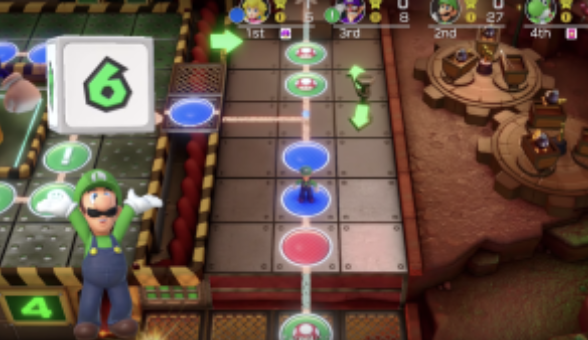
First, I’ll say off the top: I love Nintendo. I was introduced to Mario games as a kid and have many fond memories playing them with my family. The original Mario Party was one of the first games I played with my cousins and it holds a dear place in my heart. So, naturally, when I got a Nintendo Switch this past Christmas, they gave me Super Mario Party as a gift. After playing it, I instantly loved it.
Taken as a whole, I have mixed feelings about the Mario Party series, with my opinions oscillating from game-to-game. Yet there is no doubt the influence it has on my mind, as I realized that the Hopscotch game I just designed for Game Design class borrowed several elements from the series. Now, while discussing dice games in class, I revisited my newfound love for Super Mario Party.
After many years of Mario Party games that tried out new styles of gameplay, Super Mario Party returns the series back to its original style:
- Four players take turns rolling dice and moving around a board
- You collect coins via spaces and mini-games that play at the end of every turn
- You then trade coins in to buy stars, and the player with the most stars at the end wins.


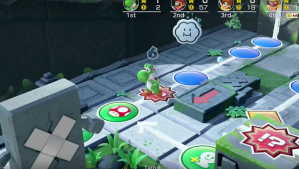
I appreciated the game’s return to what the series is at its core very much, but it was the way the game did so that made me smile. It feels like a board game now. And by incorporating some new mechanics such as meaningful character selection and Custom Dice Blocks into the gameplay, as well as by paring back some design flaws from previous games, Super Mario Party strikes a delicate balance between strategy, chance, and character.
Rather than including dozens of wacky power-ups, Super Mario Party allows players to focus on a select group of strategic items. The game also directs its focus towards the “dice” aspect of Mario Party, which makes it feel more like a board game. And, finally, it makes choosing your character a meaningful, strategic decision. In doing so, the game helps solve the series’ continuous problem of feeling too gimmicky.
What Are Gimmicks?
Gimmicks are fairly ubiquitous in Nintendo games, especially within the Mario franchise. A Mario game typically has some sort of power-up or shtick that is utilized in the gameplay. Super Mario Bros. 3 is famous for introducing players to the Tanooki Suit, and the more recent Super Mario 3D World introduces Cat Mario into the fray. Usually, however, the single-player Mario adventures are rich enough with puzzles and multi-varied levels that the gimmicks never feel like they are overwhelming the gameplay.
The same cannot be said wholly for multiplayer Mario games. These games, from Mario Tennis to Mario Kart to even Super Smash Bros., include dozens of different power-ups, and taken to the extreme create a sense of chaos that considerably reduces strategy in these cases. Basically, the gimmicks end up dominating the game more than the players’ decisions do.
Take Super Smash Bros. for example – a match played in which every item is turned up to Very High Probability is typically decided by who is standing next to a Smash Ball or Assist Trophy than on the players’ fighting abilities.

Of course, for all these games, the solution is simple: If you want to play them without gimmicks, simply turn them off. Play Mario Tennis on a standard course with no power-ups. Turn the Mario Kart items to Basic so that the game-changing Blue Shells and Bullet Bills don’t appear. Play Super Smash Bros. on Final Destination with no items appearing.
These gimmicks help make these games what they are and in small doses, they can add augmentations to strategy. If you can focus on a small number of gimmicks, you can think hard about the correct ways to utilize them. This allows you to focus both on the core gameplay mechanics as well as the utilization of the gimmicks. This is in sharp contrast with when there are too many gimmicks. Here, so much is happening that you more or feel like the gimmicks happen to you because they are too much to keep track of. That being said, sometimes wacky fun is a good thing.
Basically, in all these cases, players can self-balance the gimmicks as they choose to, in-game, for their optimal experience.
And, these games have always had meaningful character selection. As the courses and items in the Mario Kart series became more zany, you got more kart parts and weight classes related to your character choice to choose from. Super Smash Bros. has its ever-increasing cast of characters to the point it is almost overwhelming, but nonetheless allows you to make that first choice. So even if a match becomes a bout of “item warfare”, you are still running around feeling like you and your character are bringing unique abilities to the table. It’s not completely random. There was, at the very least, strategy in the character selection.


Mario Party is trickier because:
- There is no turn-off feature for items and other gimmicks, and, to be honest, Mario Party without these features is almost all luck.
- Character selection, up until Super, for the most part didn’t matter other than for aesthetic variations between them.
Note: For the case of this post, I’m mainly considering the console Mario Parties. I generally prefer the console versions because sitting around one large screen with your friends feels more communal and together than everyone individually looking at their handheld screens. Thus, I haven’t played the handheld Mario Parties much at all.
What is Mario Party’s History with Strategy?
In the original Mario Party, all of the strategy comes from the mini-games. On the board, there is some decision-making in terms of which directions to take along the boards, and there are some different star-collecting rules built into the different boards for variety, but outside of the mini-games, players are beholden to the randomness of their dice block numbers.
Mario Party 2 was the first to add items into the gameplay. In the game, you won them by landing on Item Spaces and winning subsequent single-player mini-games, or by buying them with coins. This added at least some strategy to choosing which item to buy and when to use it. Mario Parties 3 and 4 expanded on this idea by allowing you to have up to three items in your inventory.

However, in Mario Party 5, items were dropped in favor of capsules. Instead of being able to choose which items to buy, you were given capsules at random. And, although there were some capsules you could use on yourself, for the most part you threw capsules onto spaces in front of you to either try and help you or mess up your opponents. Basically, the strategy element from the previous games was minimized in favor of more randomness.
And, the variety of items expanded dramatically. Whereas the items in Mario Party 2 were either simple Mushrooms that allowed you to roll multiple dice blocks or Warp Blocks that allowed you to teleport to an opponent’s space, by Mario Party 5, there were Bob-ombs and Ukikis and Goombas that each did a different action like swapping out players’ coins or stealing coins or shuffling capsules. It became very hard to keep track of.
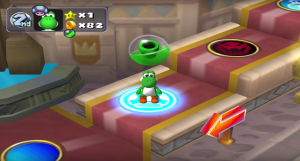
In turn, your energy while playing became dominated by figuring out what these capsules were doing. It didn’t feel good to forget which capsules did what and then have a different event happen than you expected.
Mario Parties 6, 7, and 8 tried to change this, at least somewhat, by allowing you to buy capsules of your choice from shops (called Orbs in 6 and 7, and Candies in 8), but the problem of there being too many to keep track of persisted. These games were a lot about watching different Orb or Candy Events play out when people landed on spaces, rather than on the board game gameplay.
Mario Parties 7, and 8 also reduced strategy in their endgames. For the first five Mario Parties, Bonus Stars were given out at the end of games to the:
- Mini-Game Star: The player who won the most coins in mini-games.
- Coin Star: The player who, at any point, had the highest number of coins.
- Happening Star: The player who landed on the most “? Spaces.”
This allowed you to focus on winning the most mini-games if you wanted to, or on collecting coins if you wanted to, knowing that you would get a reward at the end of it. Mario Party 6 would replace the Coin Star with the Orb Star, but the point was the same: you knew what Bonus Stars would be given out at the end and could plan accordingly.
However, starting with Mario Party 7, the series started introducing more kinds of Bonus Stars, like the Running Star and the Red Star. Out of six potential Bonus Stars, three would be given out at random at the end of a game. Another potentially strategic element reduced to chance.
Then, with Mario Party 9, Nintendo changed the direction of the series, wherein all of the players moved around in a single vehicle and shared the results of each other’s dice rolls. This was understandable, given that feedback from the more recent games was mixed. I actually enjoyed playing the game’s single-player mode, but the truth is it stopped feeling like Mario Party. Trying to collect mini-stars instead of coins in order to buy big stars was not the game I or anyone else had originally loved (although Mario Party 9 did have some great mini-games).

It is worth noting that Mario Party 9 was the first game to switch from the series’ traditional 1-10 Dice Block and to an ordinary 1-6 Dice Block. Plus, when a player jumped to hit the block, the number wouldn’t immediately pop out. The Dice Block would bounce around on screen for a bit before settling onto a number. Instead of feeling like you were hitting a power-up block in a standard Mario game, this small change helped make you feel like you were actually rolling dice inside a board game (Super retained this feature).
Speaking of dice, Mario Party 9 also introduced the concept of different kinds of dice. Instead of collecting items, you could collect 1-2-3 Dice Blocks, or 4-5-6 Dice Blocks, or Slow Dice Blocks so you could aim for a specific number. Mario Party 10, which repeated Mario Party 9’s all-in-a-vehicle style of gameplay, continued with this concept of multiple dice, introducing Double Dice Blocks into the mix.
Meanwhile (touching on the handhelds for a short bit), Mario Party Star Rush introduced players to a mechanic of finding Mario characters scattered around the board game map, bringing them onto your team, and with them a special kind of Dice Block.
Keep in mind, at this point throughout Mario Party‘s entire history, every character’s abilities were the same*. Starting with the original when you could choose between Mario, Luigi, Peach, Yoshi, Wario, or Donkey Kong, this selection was purely aesthetic. And though the roster expanded over the years, it only did so aesthetically*.
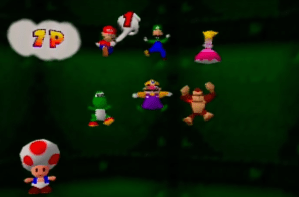
*In Mario Party 7, each pair of characters (Mario & Luigi, Peach & Daisy, etc.) had a special Orb that they could collect, which helped with character variety a little bit. Still, collecting these Orbs was inherently random, and still a few steps removed from characters having abilities that befitted the type of game you’re playing.*
So, with Super going back to the series’ traditional gameplay, what did it do to ground the series in its roots while maintaining “just” enough style to revitalize it?
Super Mario Party: Character Selection Befitting a Board Game
The biggest key, more than any other, is that it made character choice matter. In other multiplayer Mario titles, what matters (with or without the gimmicks) is the abilities of the character you choose. It is about the weight class and acceleration/speed of the Mario Kart character you choose, or the specific fighting abilities of the Super Smash Bros. character you choose. So:
- Mario Kart (Racing Game) = Specialized driving abilities
- Super Smash Bros. (Fighting Game) = Specialized fighting abilities
- Super Mario Party (Board Game) = ?
For Super Mario Party (in helping restore its board game roots), it is about the specialized Dice Block abilities of the character you choose. Each player has a special Dice Block that you can choose to roll on your turn (i.e. Mario has a 1,3,3,3,5,6 Block, Luigi has a 1,1,1,5,6,7 Block, Peach has a 0,2,4,4,4,6 Block, etc.). So, on a given turn, you can choose to roll a traditional 1-6 block or your character’s Special Block. So, you get to choose your odds with every roll. And, because these odds are connected to the character you chose, it feels like it connects back to your first, starting decision.

Plus, this feature gets augmented with the addition of Ally Spaces around the board, where you get to add an additional Mario character to your team and then get the option of rolling his/her Dice Block (similar to Star Rush). Not only is it aesthetically pleasing to watch your team of Mario characters slowly grow, it gives you more decisions to make in terms of which Dice to roll on a given turn. Allies also help you in certain mini-games, making their presence that much more valuable.


Star Rush allowed you find characters around the game board and collect them and their Special Dice Blocks, but not so with your starting character. Plus, these characters in Star Rush appeared randomly throughout the board, so it felt less like a full choice. In Super Mario Party, you get that first choice. And if the dice fail you, you can say “Well… it was my choice. I gambled and lost.”
Super Mario Party: Item Selection and Choice
Going back to items for a bit, Super Mario Party pares these down as well. It includes the traditional mushroom items that give you boosts to your Dice Block rolls, as well as a warping mechanism to go directly to the star (in this game the Golden Pipe). It also includes the Custom Dice Block, which allows you to choose your Dice Block roll number between 1 and 6, which is a tremendous bit of strategy. You can spend your money on mushrooms to go faster, or buy Custom Dice Blocks to aim your characters at the spaces you want.
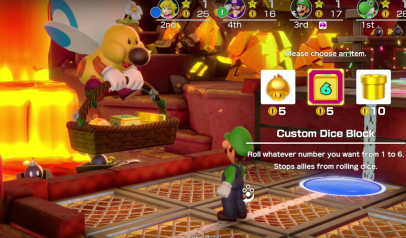
Basically, the game takes the Mario Party 2 approach of having a small group of key items for you to worry about, not a smorgasbord of wacky items that overwhelm the gameplay.
Conclusion
The original Mario Party debuted and (outside of its signature mini-games) was a game more about the randomness of your dice rolls than strategy. Mario Party 2 attempted to rectify this by adding items for you use as you saw fit, but as the series progressed, this feature began to dominate the gameplay. It made a game less about the core board game design and more about throwing items, capsules, orbs, or candies around and hoping for the best. Then, the series pivoted away completely from traditional gameplay.
Super Mario Party brought the series back, both in terms of traditional Party Mode gameplay and in terms of its board game roots, by redirecting its focus to be about the decision-making process that comes with choosing what kind of Dice Blocks to roll and how to acquire new and different ones. The game personalized these decisions by having these different Dice Blocks be connected to characters and, first and foremost, the character you initially choose.
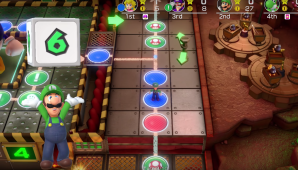
The game did what every other multiplayer Mario series had been doing for years: made character selection meaningful. And, needing items for the strategy they provide, the game pared down the amount of items to worry about so they can add to the experience, not take it over.
Of course, no game is perfect. Super still employs a randomized list of Bonus Stars to be given out at the end of a game. Only two stars are given out, but these two are chosen from a list of nine different types, and I do wish that list were smaller. I also wish that the Golden Pipe cost more in Super, as it can be sometimes easy to stock up on coins and continually buy Golden Pipes to grab stars continuously. I wish that there were more boards available to play with, and that the ones that were available were a touch bigger.
However, although some of the content might be limited, the possibility of choice and variety within that content is very strong, and I’m happy with the direction the series has taken.
Oh, and the mini-games are pretty great too.



 Matthew Floyd