
Team Size: 19
Timeframe: 4 months
Sprint Timeframe: 5 weeks
Role: Interactive Editor
Key Contributions: i4-5 (Make it rain, Snails/flowers, Show What You Know)
Learning Prompt: Where does rain come from? (Natural sciences)
Date Sprint Completed: May 2022
Skye is looking to make it down below on the flowers and her friends the snails, but the small clouds in the sky are not conducive to rain. Let’s go on a journey as a meteorologist to learn about just where rain comes from.
I worked on this project during a five-week sprint timeframe starting in April 2022, and was in charge of the second half of the experience, in which you choose where to direct the rain, make it rain, and test your knowledge of the experience.
The way On the Jobs typically work is that, after watching an embedded documentary video explaining the process of the given job, you then work through a series of smaller interactions that typically involve building some kind of material that is customizable. At the end of this experience, you are tasked with “Show What You Know” (SWYK) in a small interaction that tests what the player has learned.
In On the Job (OTJ) 108, there is less customizability, but a lot of maneuverability within the given interactions as to how you are going to direct the rain, especially in interaction 4 (i4).
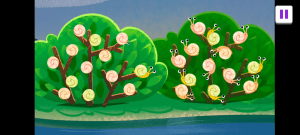
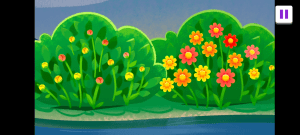
In i4, you can choose whether to water the snails or the flowers. My full playthrough involved watering the snails, but you can view the respective watering of the flowers below.
And then, regardless of which one you choose, you get a lot of freedom as to how you make it rain (i4A). You can click and drag the different rain clouds around, and as you hold them, they rain. You can also simply tap them and they will rain for a set amount of time.
This interaction became quite complex because, whether you were holding a cloud to make it rain or tapping it, the amount of rain had to linked to counting variable as well as to the clouds’ size. And once the variable reached a certain threshold, the rain would be considered emptied and the cloud would auto-shrink to “size 0,” all the while slowly changing color from a dark rain cloud to white, “empty” cloud.
This then had to be duplicated across the three clouds.
In the second half of i4 (i4B), you get to tap on either the snails or flowers. The shear number of them ended up being ambitious, as well as making sure at the programmatic rotations were accurate so that the emerge/bloom animations would be consistent with the static, idle programmatic objects.
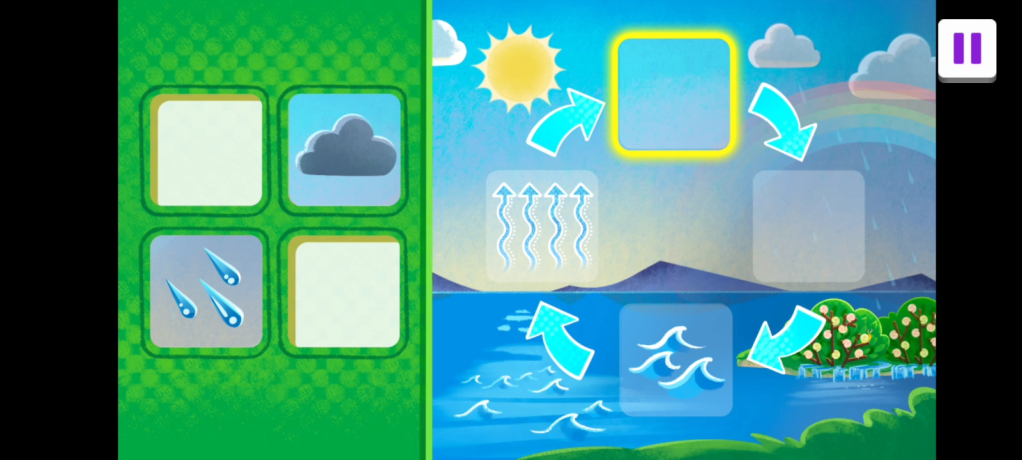
Additionally, the SWYK of OTJ108 was also moderately complex, as, in testing the player’s knowledge of the order of the water cycle, there is no set order in terms of how the player needs to drag the “event icons.”
In the production process of this mission, there ended up being a lot of additional “nice to have” quirks that we were not able to add due to time (i.e. the snails and flowers being able to turn on and off, the snails actually being able to move a little), but the experience itself came out well overall.
 Matthew Floyd