
Team Size: 15
Timeframe: 4 months
Sprint Timeframe: 5 weeks
My Timeframe: 2 weeks
Role: Interactive Editor
Key Contributions: i3 (Churner), i4 (Temperature), i6 (Bite), i7 (Show What You Know)
Learning Prompt: How do you make ice cream? (Natural Sciences)
Date Sprint Completed: June 2021
Welcome to William’s ice cream shop! In this episode of Noggin’s “On the Job” series, you get to learn the ins-and-outs of how ice cream is made, and will get to perform some of those steps yourself. Sound fun?
I worked on this project during a portion of its five-week interactive editing sprint timeline, though I myself only had two weeks in between two other projects to do my portion of the experience, which consisted of interactions 3-4 (i3-4) and interactions 6-7 (i6-7).
The way On the Jobs typically work is that, after watching an embedded documentary video explaining the process of the given job, you then work through a series of smaller interactions that typically involve building some kind of material that is customizable (see below the possibility of choosing a different ice cream flavor). At the end of this experience, you are tasked with “Show What You Know” (SWYK) in a small interaction that tests what the player has learned.
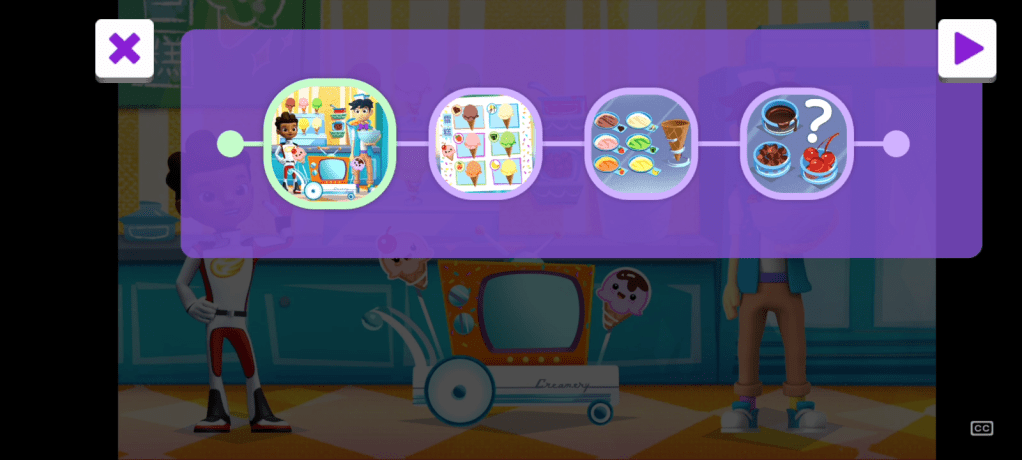
This experience’s SWYK (i7) (bottom) was very straightforward, just some touch-and-tap logic, and a highlight that comes on if the player has tapped the wrong answer more than twice.
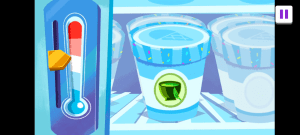
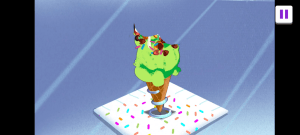
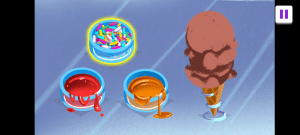
i4 (left) involved some interesting pan logic, as the player must drag the temperature gauge between two required points, and it was fun to take a captured image of the player’s ice cream cone and mask over various portions of it in i6 (right).
i3, on the other hand, was extremely complicated, as there is typically one eminently complex interaction per On the Job (OTJ). The “churner interaction” requires that the player turns a handle to churn the ice cream, which requires a variable to track the player’s overall rotation. However, as part of the interaction’s quirk, you are allowed to rotate the handle in any direction for only the first 30 degrees, and then you are locked rotating in one direction. Because the handle asset had a habit of misreading the player’s overall rotation due to this quirk, separate handle assets needed to be made invisible and visible – one for within the first absolute 30 degrees, one for clockwise, and one for clockwise – along with separate variables.
And then, the most exciting part of the churn interaction, is that halfway through your churn, the ice cream gets heavy and then the handle becomes “harder” to churn. So, basically, the logic that holds the player’s rotation needed to be linked to the handle assets and divided by two once the player passed this halfway point. And from this point on, a separate rotation variable (equivalent to the player’s rotation divided by two) needed to be added on to an absolute “720” degrees. Once the variable hit 1440, the experience would complete.
(Included below is a video of the churner on the computer, so that the drag on the handle can clearly be seen)
I’ve always considered the churn interaction to be one of the most complicated interactions I’ve worked on at Noggin.
Subsequently, I also felt tremendous accomplishment because OTJ102 became one of Noggin’s most popular experiences over the course of 2021, and the churner interaction itself was lauded for its verisimilitude.
Or maybe kids just really like to simulate making ice cream. 🙂
 Matthew Floyd